

Strategy16 min read
Bathla Group enters administration as Australia's property market sends split signals — lending, auctions, construction and what comes next
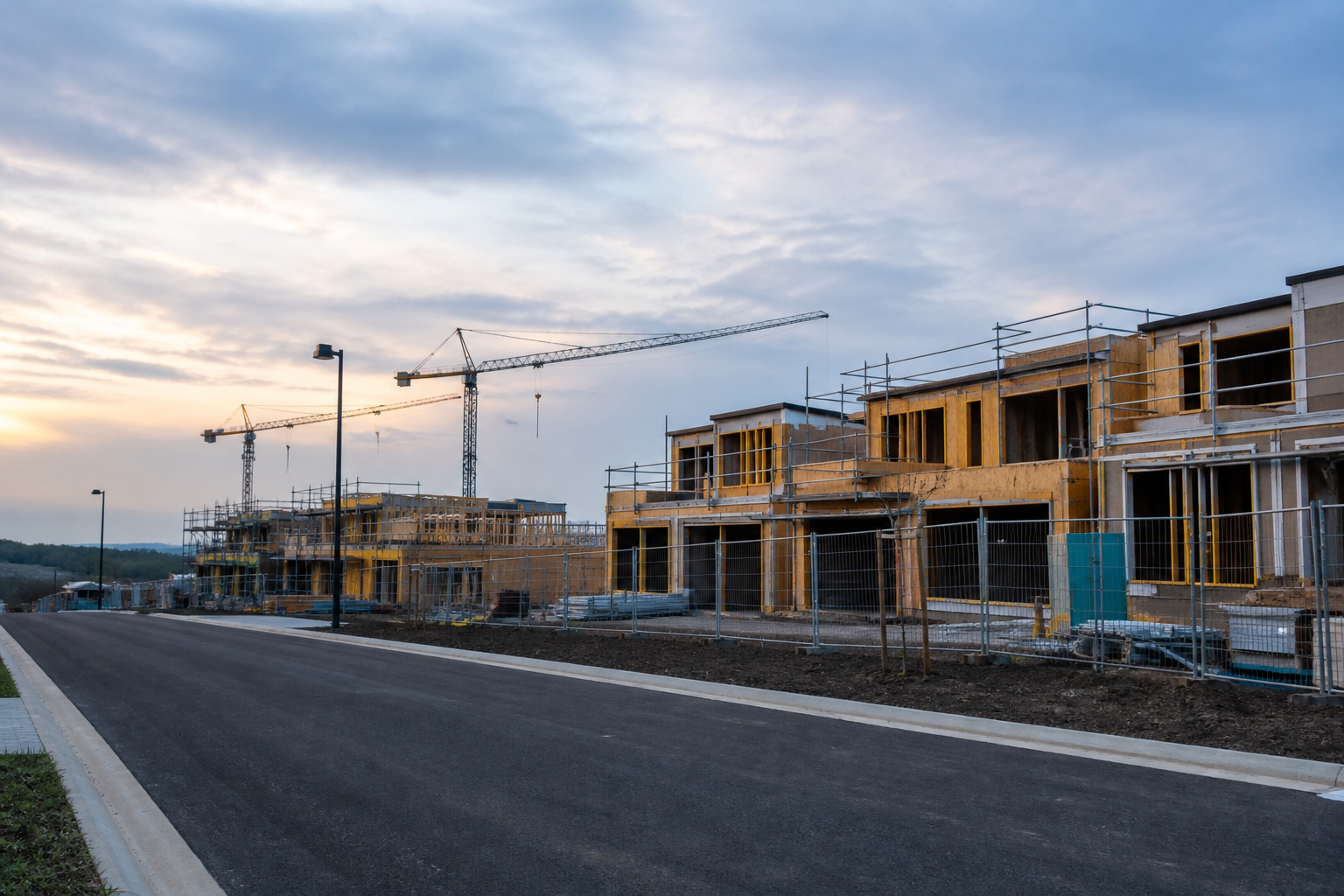
Western Sydney developer Bathla Group entered voluntary administration with roughly 2,000 homes under construction and 13,000 in the pipeline. The same week, ABS data showed softer home-loan demand, sub-50% auction clearance, rising residential construction and resilient household spending. One headline cannot explain the market.
Western Sydney developer Bathla Group entered voluntary administration this week. Administrators from Teneo were appointed to Universal Property Group and linked entities, according to filings and ABC News reporting on 25 August 2026.
That alone would dominate a news cycle. It did.
But the same week delivered a stack of official numbers — lending, construction, auctions, household spending — that point in different directions at once. Softer borrowing. Selective buyers at auction. Residential building still running hot on a year-ago comparison. Households still spending.
This article lays out what was reported, what the ABS and Cotality figures show, and what is scheduled next. It is general information and news context only. It is not personal financial advice, a recommendation to buy or sell property, or a forecast that any lender will approve your application.
For the July 2026 CPI print and what it means for the 29 September decision, see our separate Australia inflation rate July 2026 guide. For Cotality's August 2026 Home Value Index — 93% of capital-city suburbs declining — see the September property downturn mortgage playbook. This piece does not repeat that analysis.
Bathla Group: what administrators reported
Voluntary administration means an independent administrator takes control of a company in financial distress and assesses whether it can be restructured or should be wound up. Creditors usually vote on the path forward at a later meeting.
On the facts reported publicly so far:
| Item | Reported figure / detail | Source |
|---|---|---|
| Administration date | Appointed 25 August 2026 | ABC News |
| Main corporate entity | Universal Property Group | ABC / ASIC records |
| Liabilities (prior year accounts) | $3.2 billion as at 30 June 2025 | ABC, citing corporate disclosures |
| Homes under construction | Roughly 2,000 | ABC follow-up |
| Development pipeline | About 13,000 additional dwellings | ABC, citing administrators |
| Short-term funding sought | About $20 million to sustain five weeks of building activity | ABC, citing administrator communications |
| Administrator | Teneo | ABC / ASIC |
Bathla is a large developer of lower-cost homes, townhouses and apartments across Western Sydney — suburbs such as Schofields, Marsden Park and Tallawong appear repeatedly in coverage. Its corporate structure is complex: ABC reported hundreds of subsidiary entities under Universal Property Group.
Managing director Bhart Bhushan described a “perfect storm” of softening sales, tax-change impacts and higher construction costs in a social-media statement quoted by ABC. Chief executive Robert Loader cited declining sales, falling property prices and rising build costs.
What this is: financial distress at one major private developer with thousands of buyers, contractors and lenders in the chain.
What it is not, by itself: proof that the entire Australian property market has collapsed. Administrations happen in cycles. The scale here — projects in flight, private-credit exposure, subcontractor payments — is why the story matters for housing supply and confidence, not because every suburb moves in lockstep with one balance sheet.
Private credit: why regulators spoke up the same week
Much of Bathla’s reported debt sat outside the big four banks. ABC said the majority of Universal Property Group’s liabilities as at June 2025 were owed to private credit funds — non-bank lenders that finance development when traditional bank appetite thins.
On 27 August 2026, ASIC chair Sarah Court told a Sydney audience the sector was facing its “first real test” and that Australia was seeing the “first significant cracks” as large borrowers failed and some funds limited redemptions.
Court stressed that many Australians hold indirect exposure through superannuation allocations to private credit. ASIC said it would publish further research later in 2026.
Property development in Australia has never relied on bank debt alone. When a large developer enters administration, the ripples can reach lenders, fund investors, builders, subcontractors, suppliers — and buyers waiting on unfinished homes. ABC carried stories of off-the-plan purchasers facing repeated completion delays.
That chain is why Bathla landed in the same news week as ASIC’s warning. It does not automatically mean systemic failure. It does mean the funding layer behind greenfield housing is under fresh scrutiny.
Home-loan demand: cooler June quarter, not a full stop
While Bathla dominated front pages, the ABS released Lending Indicators, June Quarter 2026 on 14 August 2026. The national borrowing picture cooled:
| Segment | Change, Mar qtr → Jun qtr 2026 (number) | Change (value) |
|---|---|---|
| Total new dwelling commitments | −5.4% | −5.2% |
| Owner-occupier | −3.3% | −1.9% |
| First home buyer (owner-occupier) | −2.9% | +0.2% |
| Investor | −8.6% | −10.2% |
Total commitments numbered 134,225 in the quarter; total value $97.6 billion. The ABS noted this was the second consecutive quarterly fall in value — the first back-to-back decline in more than three years.
Investors led the retreat. Owner-occupier and first-home-buyer numbers eased too, but less sharply.
One detail easy to miss: compared with the June 2025 quarter, investor commitments were still 2.8% higher in number and 8.1% higher in value. Demand softened quarter-on-quarter. It did not vanish.
ABS head of finance statistics Mish Tan linked the shift to lending conditions during a quarter when the RBA raised the cash rate for a third time in 2026, and to May budget announcements on future negative gearing and capital gains tax changes effective from 1 July 2027.
This is national settlement data — not one bank’s application counter. It measures what actually committed, including construction, new and existing purchases.
Construction: headline down, housing up
On 26 August 2026 — the day after the July CPI release — the ABS published preliminary Construction Work Done, June Quarter 2026. The top-line number looked soft. The housing detail did not.
| Measure | Jun qtr 2026 | Quarter change | Year-on-year change |
|---|---|---|---|
| Total construction | $82,516m | −2.1% | +2.7% |
| Building work done | $45,844m | +1.3% | +10.0% |
| Residential building | $27,867m | +1.7% | +9.1% |
| Non-residential building | $17,977m | +0.5% | +11.5% |
| Engineering construction | $36,672m | −6.0% | −5.1% |
Total construction fell because engineering work dropped sharply. Residential building work done rose in the quarter and sits 9.1% above the same quarter in 2025.
Read that next to Bathla: Australia still needs housing supply; work on site nationally was expanding on a year-ago basis even as one major developer sought emergency funding to keep its own sites moving.
Approvals are not completions. Finance is not a slab pour. A viable builder still has to finish the job and settle with a buyer. The supply chain has more links than a single chart captures — which is precisely the tension this week exposed.
Auctions: buyers still selective
Cotality final data for the week ending 23 August 2026 showed a 48.2% weighted clearance rate across combined capital cities — down from 48.9% the prior week and the 12th week below 50% in the past 13.
Cotality economist Annabelle Mezieres noted the rate was roughly 70% at the same time in 2025 — about 21.8 percentage points higher.
City final clearance rates (week ending 23 August 2026):
| City | Clearance rate | Auctions | Notes |
|---|---|---|---|
| Melbourne | 51.9% | 594 | Largest market by volume |
| Sydney | 50.3% | 477 | Only capital to improve week-on-week |
| Brisbane | 32.7% | 151 | Weakest major-capital result in the sample |
| Adelaide | 46.7% | 90 | — |
Preliminary rates earlier in the week read higher; finals settled lower — normal auction reporting dynamics.
Auction clearance is not the whole housing market. Many properties sell privately. Still, when clearance spends months below 50% while the cash rate sits at 4.35%, it tells you bidders are choosier than they were a year ago.
Household spending: still rising in July
Not every household signal pointed down. The ABS Monthly Household Spending Indicator, July 2026, released 27 August 2026, showed spending up 1.1% in the month on a seasonally adjusted basis — a third consecutive monthly increase after +1.0% in June and +1.2% in May.
In nominal terms, July spending was 7.0% higher than July 2025 — the strongest annual pace since June 2023, according to the release.
Categories contributing included recreation and culture, food, hotels, cafes and restaurants, and health. The ABS also noted fuel spending movements linked to changes in fuel excise from 1 July 2026.
Resilient spending alongside softer auction clearance and cooling loan commitments is not a contradiction. Households can keep consuming while property turnover slows — especially when migration, services inflation and delayed project completions all pull in different directions.
The week's split picture — in one table
| Signal | Direction | Latest reading | Source |
|---|---|---|---|
| Major developer stress | Stress event | Bathla administration; ~2,000 homes under construction | ABC / administrators |
| New home-loan commitments | Softer | −5.4% in June quarter (number) | ABS Lending Indicators |
| Residential construction work | Stronger YoY | +9.1% vs June quarter 2025 | ABS Construction Work Done |
| Auction clearance (combined capitals) | Soft | 48.2% final, week to 23 Aug | Cotality |
| Household spending | Firmer | +1.1% in July; +7.0% YoY nominal | ABS |
| Headline inflation | Eased but above target | CPI 3.5%; trimmed mean 3.6% | ABS (26 Aug) — detail here |
One headline cannot explain a market sending five different signals at once.
What to watch next week
Three dates matter for the property and mortgage story heading into September:
Tuesday 2 September 2026 — Building Approvals (July) and GDP (June quarter)
The ABS calendar schedules both for 11:30am AEST:
- Building Approvals, Australia, July 2026 — early pipeline signal. June approvals rose 7.2% to 18,328 dwellings (seasonally adjusted). July will show whether momentum held.
- Australian National Accounts, June quarter 2026 — GDP, household consumption, business investment. The March quarter showed 0.3% GDP growth in chain-volume terms.
Approvals tell you what may get built. GDP tells you whether the broader economy is absorbing higher rates without cracking.
Friday 4 September 2026 — Bathla creditors' meeting
Administrator communications referenced a first creditors' meeting on 4 September 2026. Outcomes could clarify which projects continue, which stall, and how subcontractor and buyer claims will be handled. Treat social speculation as noise until formal administrator updates land.
If you own property, are buying, or carry a mortgage
This section is context, not instruction.
Off-the-plan and unfinished builds: If your contract sits inside an administered group, monitor administrator notices, your contractual rights, and any communications from the developer. Legal advice sits with a property lawyer — not a blog.
Borrowing conditions: Softer commitment data reflects tighter serviceability after 2026 rate rises. Lenders still assess applications individually. A national quarterly fall does not tell you whether your file would pass today.
Auction vs private treaty: Sub-50% clearance in most capitals suggests less urgency on the buyer side at auction. That is market colour — not a rule that every suburb or price point behaves the same way.
Rates and inflation: The cash rate is 4.35% until the Board changes it. July CPI eased to 3.5% annually but trimmed mean held 3.6%. For a mortgage-focused checklist, use the July CPI guide and the August RBA hold playbook.
If you want a second read on your home loan — current rate, remaining term, retention versus switching — after this week's news, Speak to a broker. Bring a recent statement if you have one. General information only; approval is never guaranteed.
FAQ
Did Bathla Group collapse?
It entered voluntary administration — a formal insolvency process — not automatic liquidation. Administrators are assessing whether parts of the group can continue operating or be sold. Outcomes depend on creditor votes and funding.
How many homes are affected?
Administrators cited roughly 2,000 homes under construction and about 13,000 in the broader pipeline. Buyer and subcontractor impacts vary project by project.
Why are home loans falling while construction rises?
Loans measure new finance commitments settling in a quarter. Construction work done measures activity on sites already underway. A pipeline can keep building while new borrowing cools — until finance, approvals or builder viability interrupt future starts.
Are auction clearance rates always below 50%?
In combined capitals, Cotality finals have spent most of 2026 below 50%. Sydney and Melbourne finals were near 50–52% for the week to 23 August; Brisbane was far weaker at 32.7%.
Where should I read the primary sources?
- Bathla administration: ABC News
- Lending: ABS Lending Indicators
- Construction: ABS Construction Work Done
- Auctions: Cotality auction results
- Spending: ABS Household Spending Indicator
- Private credit: ABC on ASIC remarks
Next step: Speak to a broker · Home loan review · Refinance playground · July 2026 CPI guide · Apply pathway
Sources accessed 28 August 2026 unless otherwise dated. News and statistics can be revised. This article is general information only — not personal financial, legal or tax advice.
Azure Home Loans — general information only, not personal credit advice.
Quick check
Am I paying too much?
Enter your loan balance and current rate for an indicative saving band — lighter than a full refinance model. Not a quote; book a review when you want retention vs external lenders checked on your file.
Indicative saving band
$98 – $233/mo
- Rate band (illustration)
- 5.85% – 6.20%
- Repayment could land around
- $3,540 – $3,675/mo
Continue on this topic
Selected internal links curated for crawlers + readers tracing the same journey — calculators, glossary, service FAQs, hubs.
- Cash flow calculator guide
What a serious investment cash-flow model should show — and the free Deal Analyser.
- Property investor hub
Portfolio structure, rent shading, and cashflow playground for investor posts.
- Refinance hub
Macro strategy posts often dovetail with refinancing or equity repositioning.
Next step
When you want the same themes applied to your file — lender policy, documentation, and structure — Speak to a broker, browse mortgage broker services, or start the apply pathway. Bishnu Adhikari will reply with a sensible next move.