

Construction loans
Construction loans Australia 2026 — the complete guide for new builds, knock-down-rebuilds and major renovations.
Construction lending in Australia is genuinely different from a standard home loan — progress payments instead of a lump-sum drawdown, interest-only during build, valuer site inspections at every stage, and lender scrutiny of your builder, contract, insurance, and contingency story. This guide covers fixed-price contracts, the standard six-stage progress payment schedule, valuations at each stage, owner-builder restrictions, knock-down-rebuild timing, holding-cost buffers, off-the-plan vs single-contract builds, three worked case studies, and 25+ FAQs. Bishnu Adhikari at Azure Home Loans structures the file before soil turns and stays close through every progress certificate. General information only — not personal financial or legal advice.
Who this page is for
Borrowers planning to build a new home (single contract, design-and-construct, or owner-builder), buying land first then building, knocking down an existing dwelling and rebuilding (KDR), buying off-the-plan, or undertaking a major structural renovation that needs construction-style progressive drawdown. The page is also useful for first home buyers considering a house-and-land package and investors building rental properties.
Who you are dealing with
On this construction loans pathway you deal directly with Bishnu Adhikari at Azure Home Loans — licensing, process, and responsible-lending boundaries below.
- Broker
- Bishnu Adhikari
- Licensing
- ACR 538895, auth. under ACL 390261 (Yellow Brick Road)
- ABN
- 77 676 207 131
How a file usually moves
Step 1
Enquiry
Share goals, income type, and timeline — no obligation to apply.
Step 2
Document plan
We map what lenders usually need for your file shape before you lodge.
Step 3
Lender match
Policy-led comparison across lenders — trade-offs in plain English, not a rate race.
Step 4
Lodge when ready
You decide whether to apply. Responsible lending assessment still applies.
Responsible lending
Credit assistance is subject to assessment, verification, and lender policy. We do not guarantee approval, savings, eligibility for any scheme, or a “best rate”. General information on this site is not personal credit advice — about the broker · apply pathway.
What matters most for a construction file
- A licensed, insured builder with a fixed-price contract — the single most important credit factor; lenders scrutinise the builder’s licence, insurance, and trading history.
- A contract that fits a standard 5–6 stage progress payment schedule — lenders dislike non-standard contracts or multiple builders without a head contractor.
- Land already settled (or settling concurrently) with title clear of restrictive covenants and any required council or strata consents.
- Adequate contingency — lenders typically require 5–10% above the contract price to cover variations, weather, supply chain disruption.
- Holding-cost cash flow during build — you may pay rent or your existing mortgage AND interest-only on the construction draws simultaneously for 9–18 months.
- Builder’s All Risk insurance and Home Warranty Insurance (or state equivalent) before first draw — lenders require evidence at settlement.
- Realistic post-completion valuation — the lender values "as if complete" using your contract; a soft market or out-of-spec build can produce shortfalls at final inspection.
How we help with construction lending
Construction files fail at four predictable points: (1) builder doesn’t meet lender criteria, (2) contract format triggers credit review, (3) cash buffer too thin to absorb variations, (4) draws stall mid-build because of paperwork. Bishnu Adhikari pre-checks your builder and contract against lender criteria before you sign, structures the loan with the right contingency and IO term, sets up draw certificates correctly, and stays in the loop through each progress payment. We coordinate with your conveyancer and builder so progress payments arrive on schedule — not 3 weeks late while trades wait. General lending guidance only — we are not a replacement for your contract solicitor or financial planner.
Common pitfalls before you commit
- Loose or "cost-plus" contracts instead of fixed-price — most lenders will decline or re-classify.
- Variations during build that aren’t pre-funded — a $50,000 mid-build extra needs cash, not "we’ll add it to the loan."
- Owner-builder lending — most major lenders won’t lend to owner-builders; specialist non-bank options exist but at higher rates and lower LVR.
- Knock-down-rebuild timing — demolishing the existing house wipes out the security mid-process; lenders need contracts and timing aligned.
- Off-the-plan settlement risk — 12–24 months between contract and completion; market and your circumstances can change. Sunset clauses can leave you exposed.
- Underestimating holding costs — rent + construction interest + storage + temporary accommodation for 12–18 months adds up to $30,000–$60,000 of cash flow.
- Skipping the post-completion valuation reality check — if final value comes in lower than contract, you may need extra cash at handover.
How it works
Step 1
1. Plans, builder & contract review
We confirm your builder is licensed and insured, contract format fits lender requirements, and council approvals are on track — before you sign.
Step 2
2. Borrowing capacity & contingency planning
We model the loan including a 5–10% contingency, IO during build, and your holding-cost buffer (rent + existing mortgage if applicable).
Step 3
3. Approval, settlement & first draw
Loan settles; if buying land, that funds first; deposit drawn to builder; insurance evidence on file; construction begins.
Step 4
4. Progress payments through to completion
At each stage — base, frame, lock-up, fixing, completion — valuer inspects, you sign progress certificate, lender funds the next draw.
Building is exciting and stressful in equal measure. Start the lending conversation 2–3 months before you sign a contract — it gives time to fix anything the lender will flag.
Tax, legal, and contract decisions
Construction contracts are a legal document with implications across building law, consumer protection, and dispute resolution. Always have a building solicitor review the contract before you sign — we can flag credit-side issues but we do not give legal advice. For tax (CGT base, GST on new build, depreciation schedules), your accountant is the right point of contact.
Licensed broking
General information on this page is not personal credit or financial product advice. Credit assistance is provided by Bishnu Adhikari (ACR 538895, auth. under ACL 390261, Yellow Brick Road) and is subject to lender assessment, policy, and verification — outcomes are not guaranteed.
1. Construction loan vs standard home loan — the genuine differences
A construction loan is structurally different from a standard purchase home loan. Knowing the differences prevents confusion at every stage.
| Element | Standard home loan | Construction loan |
|---|---|---|
| Drawdown | One lump sum at settlement | Progressive in 5–6 stages over 6–18 months |
| Repayments during build | P&I from settlement | Interest-only on the drawn-down balance |
| Valuation | Once, at application | Initial + at each progress stage (sometimes only at completion) |
| Lender scrutiny of builder | Not relevant | Builder must be licensed, insured, on lender’s acceptable list |
| Contract format | Real estate purchase contract | Fixed-price building contract (HIA or Master Builders standard preferred) |
| Insurance required | Building insurance at settlement | Builder’s All Risk + Home Warranty + your contents from completion |
| Title | Transfers at settlement | You own the land + improvements as built |
| Maximum LVR | 95% (LMI above 80%) | 90–95% (lender-specific; some cap at 80% for owner-builders) |
| Available lenders | Most lenders | Major banks + selected non-banks; smaller pool |
| Loan term during build | n/a | Typically 12 months IO build period |
| Conversion at completion | n/a | Loan converts to standard P&I (or you can refinance) |
What the lender is actually buying
For a standard home loan, the lender lends against an existing, valued asset. For a construction loan, the lender lends against an asset that does not yet exist — they’re betting on your builder’s ability to deliver to specification on time, on budget. That’s why scrutiny on the builder, the contract, and your contingency cushion is so much higher.
2. The standard six-stage progress payment schedule
Most Australian residential construction contracts follow a standard 5- or 6-stage progress payment schedule. The percentages are set by the contract, but lenders generally accept HIA and Master Builders Association standard contracts. The most common schedule:
Stage 1 — Deposit (5% of contract). Paid on signing or at land settlement, before construction starts. Builder uses this for initial site setup and ordering.
Stage 2 — Base / slab (15–20% of contract). Concrete slab or floor structure poured. Lender valuer inspects to confirm work is complete to spec.
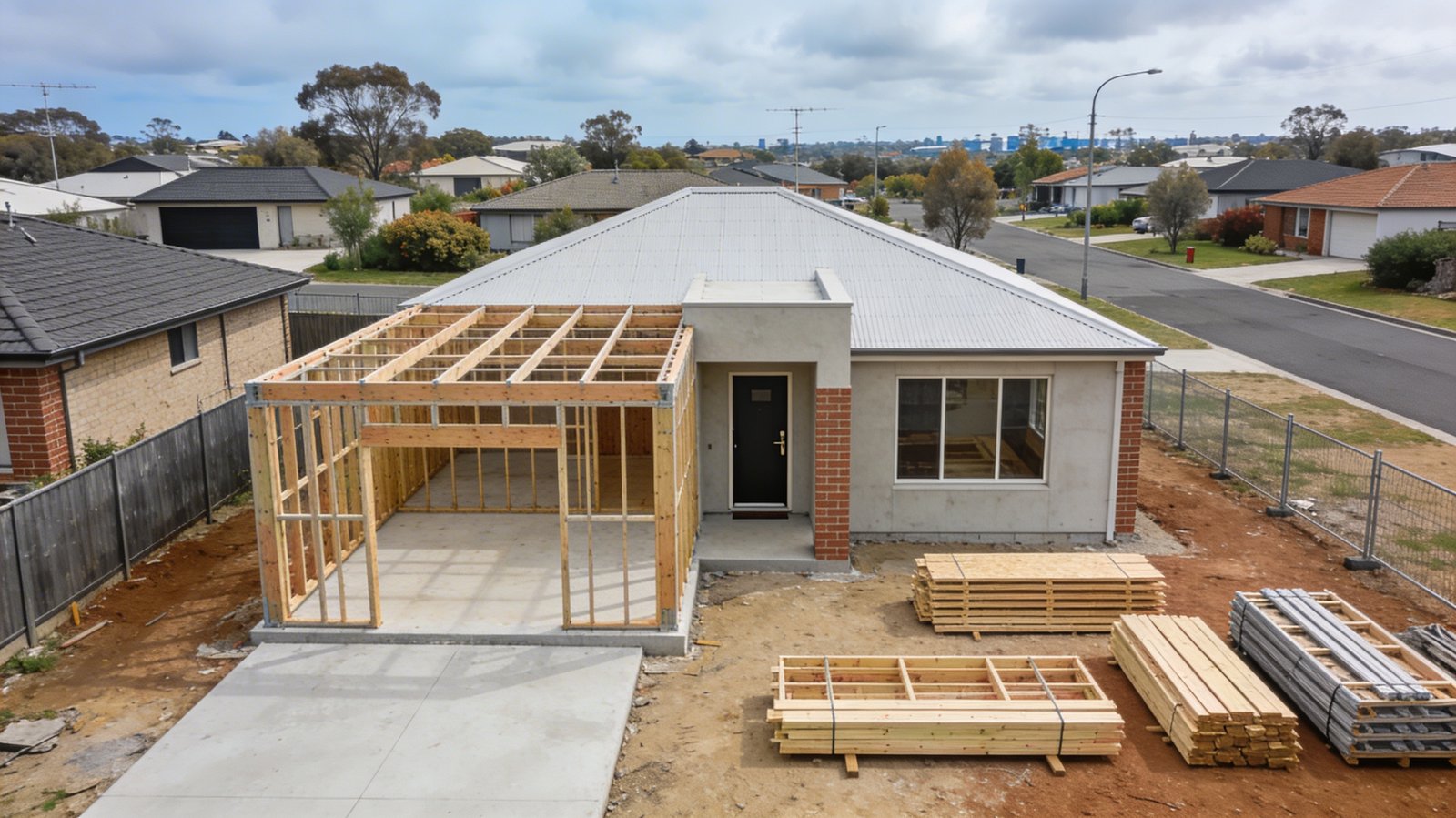
Stage 3 — Frame (15–25% of contract). Walls, roof trusses, and structural framing complete. House is "framed up" but not enclosed. Valuer reinspects.
Stage 4 — Lock-up / enclosed (20–25% of contract). External walls, doors, windows installed. Roof on. House is weather-tight and "lockable." Valuer reinspects.
Stage 5 — Fixing / fit-out (20–25% of contract). Internal walls, kitchen, bathroom, electrical, plumbing. Mostly complete inside; final fittings being installed.
Stage 6 — Completion / final / practical completion (5–15% of contract). All works complete, final inspection, certificate of occupancy or compliance issued. Final draw releases.
How a draw actually happens
- Builder issues a progress claim to you stating the stage is complete.
- You sign and authorise the claim (and review it carefully — once signed, the lender will pay).
- The lender sends a valuer to inspect the works (usually within 3–7 business days).
- Valuer confirms work has been completed to the stage standard.
- Lender releases funds to the builder’s nominated account, usually within 2–5 business days.
What can go wrong at draw time
- Valuer finds defects or incomplete work — lender holds the draw until issues remedied. You may need to pay the builder out-of-pocket and reclaim later.
- Builder over-claims (claims a stage is complete when not) — valuer disputes; delays.
- Title or insurance issues — lender holds draw pending paperwork.
- You haven’t signed the progress claim — lender can’t release. Most common cause of delays.
A typical clean draw takes 7–14 business days from progress claim to funds released. Build cash flow assumes about 4 weeks per stage.
3. Fixed-price contracts — what lenders actually require
Lenders strongly prefer fixed-price building contracts because they cap the risk: if the build cost runs over, the builder bears the difference (subject to permitted variations). Cost-plus and "best endeavours" contracts are very rarely accepted by major banks.
Acceptable contract formats (most lenders)
- HIA Lump Sum Building Contract (Housing Industry Association — the most common).
- MBA Lump Sum Residential Building Contract (Master Builders Association).
- Standard contracts in Victoria (HIA Vic), NSW Fair Trading-style, etc.
- Some lenders accept custom legal contracts on a case-by-case basis if they include all of: fixed price, defined scope, progress payment schedule matching lender stages, and standard variation clauses.
What lenders look for in the contract
- Total contract price clearly stated. This is what the loan funds against.
- Provisional sums and prime cost items disclosed. These are line items where the price is an allowance, not fixed (e.g., $35,000 for "kitchen — to be selected"). Lenders typically count these as fixed for credit purposes; you bear the cost overrun risk.
- Progress payment schedule. Stage names and percentages should match (or be mappable to) lender stages.
- Variation clauses. Should be specific — written variations only, signed by both parties, with cost/time impact stated.
- Liquidated damages or penalty clauses. Some lenders prefer these; others don’t require them.
- Builder’s licence and insurance numbers in the contract.
Variations — the silent budget destroyer
Variations are changes to the contract during build — you decide to upgrade the kitchen, add a room, change the flooring. They are not pre-funded by the construction loan. You either pay variations from cash, or apply for a top-up loan after a fresh valuation.
Rule of thumb: budget 5–10% of contract price for variations as a separate cash buffer. Builds without variations are almost unheard of in 12–18 month projects.
Common contract red flags lenders flag
- Cost-plus pricing without a guaranteed maximum.
- Multiple builders for different trades without a head contractor.
- Vague scope ("kitchen as discussed") without specifications.
- Non-standard payment schedules (e.g., 50% upfront, 50% on completion).
- Builder is owner-builder (no licensed builder taking head contract responsibility).
- Builder has had recent insolvency or is operating under a phoenix structure (lenders increasingly check records).
Why Master Builders or HIA standard wins
Standard contracts have been negotiated over decades to balance builder and consumer interests, comply with state building law, and align with lender progress payment templates. Custom contracts almost always trigger lender legal review and delay. Use a standard contract unless your solicitor has a strong reason not to.
4. Owner-builders, knock-down-rebuilds, and renovations
Owner-builders
An owner-builder is someone who acts as their own head contractor — managing trades, ordering materials, coordinating the build — instead of engaging a licensed builder. Lenders treat this as significantly higher risk:
- Major banks generally decline owner-builder construction loans. Some make exceptions for borrowers who hold a builder’s licence themselves.
- Specialist non-bank lenders (Pepper, Liberty, La Trobe) lend to owner-builders at:
- Lower (typically max 70–80%, vs 90–95% for licensed-builder construction).
- Higher rates (typically 0.50–1.50% above prime construction).
- More restrictive draw schedules (often inspections at every stage, no exceptions).
- Owner-builder permits are required in most states (NSW, VIC, QLD, etc.) — the state issues a permit confirming you can act as your own head contractor for that specific build.
- Insurance is more limited — you can’t access builder’s All Risk insurance through a builder; you need direct policies.
For most borrowers, engaging a licensed builder is materially cheaper and easier to finance even if it costs more in builder margin. The savings on owner-build are often eaten up by higher rate, lower LVR, and time spent managing trades.
Knock-down-rebuild (KDR)
KDR is buying or owning a property, demolishing the existing house, and building a new one on the same land. Common in established suburbs where the land is valuable but the existing house is undersized.
The credit twist: during demolition, the security has lower value (just the land); the lender must fund both the demolition and the new build, often without a clean post-demolition revaluation. Most lenders will:
- Lend against the land value (post-demolition).
- Fund the new build progressively as a standard construction loan.
- Require the build to start within an agreed window post-demolition (typically 30–90 days) to limit the time the security sits as bare land.
Practical tip: sequence the demolition and build start carefully. A 2-month gap between demolition and slab pour is acceptable; a 6-month gap leaves the land sitting unimproved, which lenders dislike.
Major renovations (structural)
For renovations that involve structural work — second-storey additions, full kitchen/bathroom rebuilds, extensions — a construction-style progressive drawdown is often appropriate. If the renovation is cosmetic only ($30k–$80k of cosmetic upgrades), a regular home loan top-up or personal loan is often simpler.
Lender criteria for renovation construction loans:
- Fixed-price contract from a licensed builder.
- Renovation cost typically 20%+ of property value (smaller renos go on top-up).
- Pre and post-renovation valuation.
- Council approvals where required.
Off-the-plan purchases
Off-the-plan is technically not construction lending — you don’t receive progressive draws. It’s a single-contract purchase with a long settlement (12–24 months between contract and completion). The developer builds; you pay the deposit at contract; you pay the balance at settlement when the build is complete.
Lender treatment:
- Full pre-approval at contract is rarely possible because the property doesn’t exist yet — most lenders give "indicative pre-approval" subject to formal application closer to settlement.
- Final approval and valuation happen 60–90 days before settlement.
- Settlement risk: if the property values lower than contract at completion, you may need extra cash. If the market has fallen 10% from contract date, you could be ~$70k short on a $700k purchase.
- Sunset clauses — if the build runs past the sunset date in the contract, the developer can sometimes terminate. Have your solicitor review carefully.
Off-the-plan deserves its own sub-strategy and is best discussed file-by-file.
5. The holding-cost cash flow — the budget item most borrowers miss
During a 12-month build, you typically have:
- Existing housing cost. Rent, or your existing mortgage if you’re building a second home, or temporary accommodation if you’re KDR-ing.
- Construction loan interest. Interest-only on the drawn-down balance, increasing each stage as more is drawn.
- Storage costs if you’ve moved out and put belongings in storage.
- Bridging-style costs if you’ve sold your old place and are renting.
A worked holding-cost example
Setup: You’re building a $550,000 contract on land you’ve already bought. You’re currently renting at $650/week. Build period 12 months.
Construction loan drawdowns over 12 months (assume even):
| Month | Cumulative drawn | Monthly interest at 5.94% IO |
|---|---|---|
| 0 | $27,500 (5% deposit stage) | $136 |
| 2 | $137,500 (base/slab) | $681 |
| 4 | $275,000 (frame) | $1,361 |
| 6 | $412,500 (lock-up) | $2,043 |
| 8 | $522,500 (fixing) | $2,587 |
| 12 | $550,000 (completion) | $2,723 |
Approximate total construction loan interest over 12 months: ~$16,000.
Plus rent over 12 months at $650/week: $33,800.
Plus storage, moves, contingency for variations: ~$5,000–$10,000.
Total holding costs: ~$55,000–$60,000 over the 12-month build period.
This is on top of the deposit, build cost, and contingency. It must come from cash flow during the build, not from the loan.
How to plan for this
- Calculate it before you sign the build contract.
- Build a buffer of 6 months’ worth into a savings account — don’t rely on monthly cash flow to absorb it.
- Ask your lender if there’s a "construction interest capitalisation" option. Some lenders allow interest during build to be added to the loan rather than paid monthly — reduces immediate cash strain but increases the final loan balance.
- Stress-test for a 3-month delay on completion. Most builds run 1–3 months over schedule; budget for the delay.
6. Three worked case studies
Composites built from real client scenarios with names and numbers altered. Illustrative only.
Case study A — First home buyer, house-and-land package
The borrower: Liam, 30, single, software engineer. Income $135,000.
The plan: House-and-land package in Sydney’s south-west. Land $310,000 (settles first); build contract $480,000 (single-contract turnkey from a major project builder). Total project $790,000.
The structure:
- Stage 1 — Land settlement. $310,000 land settles. Liam contributes $40,000 deposit + $13,000 stamp duty. Borrows $270,000 secured against land.
- Stage 2 — Construction loan. Builder’s contract $480,000. Liam adds $20,000 from FHSSS-released super to deposit. Borrows additional $460,000 progressively.
- Total final loan: $730,000 against estimated post-completion value of $850,000. Final 86%; applies but eligible (under uncapped FHG from October 2025), so LMI waived.
The cash flow during build (12 months):
- Construction loan interest (cumulative): ~$15,500.
- Rent at $480/week: ~$25,000.
- Total: ~$40,500.
Pre-funded buffer: $20,000 cash kept aside specifically for variations and overrun. Used $11,000 on landscaping and an upgraded oven.
Outcome: Build completed in month 13 (1 month over schedule, normal). Liam moved in. Loan converted to standard at 5.84% over 30 years. Repayment $4,290/month, comfortable on his income.
Key lesson: House-and-land packages from established project builders are the cleanest construction lending file pattern. Choose a builder with strong lender accreditation and a HIA standard contract, and the process flows smoothly.
Case study B — Knock-down-rebuild upgrader
The borrowers: Karen and Pradeep, ages 42 and 44. Two children. Existing weatherboard house in inner-Melbourne purchased 11 years ago for $620,000; now worth $1,150,000 (mostly land value). Current loan: $185,000.
The plan: Demolish existing house and build new 4-bedroom contemporary home for $1,150,000. Family rents elsewhere during build.
The structure:
- Refinance existing $185,000 loan; release equity.
- Demolition contract: $25,000 (paid from cash plus initial draw).
- New build contract: $1,150,000 fixed-price with established builder.
- Land value post-demolition: $980,000. New post-completion estimated value: $1,950,000.
- New loan total: $1,235,000 (existing $185k + demolition $25k + build $1,025k after deposit). LVR 63% on completion value.
Cash flow during build (estimated 14 months):
- Construction loan interest (cumulative): ~$45,000 (larger loan, longer build).
- Rent at $850/week: ~$51,500.
- Storage + moves: ~$8,000.
- Variations buffer: $40,000 (used $26,000).
- Total holding costs: ~$130,000 + variation spend.
The outcome: Build delivered 15.5 months from demolition (5 weeks over). Family moved in. Loan converted to P&I; new effective LVR 60%.
Key lesson: KDR is expensive in cash-flow terms even when the underlying numbers work. The $130,000 of holding costs and variations was funded from $50k pre-saved + $80k drawn down from offset and re-paid post-completion.
Case study C — Investor building a duplex on dual-key land
The investor: Hassan, age 51, existing investor with three properties. Strategy: buy a 700m² lot, subdivide in principle (already approved), build a duplex — hold one unit, sell the other to extract gain.
The numbers:
- Land: $590,000.
- Build contract (duplex): $710,000 fixed-price.
- Total project: $1,300,000.
- Estimated completed value: held side $830,000; sold side $830,000.
The structure:
- Investment-purpose construction loan at 6.34% (investment construction, slightly higher than owner-occupied construction).
- LVR 70% on completion value: $1,820,000 across both finished units. Loan: $1,275,000.
- Hassan contributes $200,000 cash for deposit + costs + holding cost buffer.
Cash flow during 14-month build:
- IO interest cumulative: ~$58,000.
- No rental income during build (vacant land + new build).
- Funded from offset against existing portfolio.
At completion:
- Sell unit B for $830,000 (less GST on new build, less agent and legal): net ~$760,000.
- Use proceeds to pay down loan to $515,000 against held unit A (worth $830,000); LVR 62%.
- Held unit A is now an income-producing investment with $42,000/year rental income.
Key lesson: Build-to-sell-one-keep-one strategies require a clean structure from the start — the lender needs to know the strategy at application, the GST implications need accountant input early, and the contract needs to identify the two units separately for clean sale of one. Hassan’s pre-build accountant engagement saved at least $30,000 in restructuring costs at sale.
7. Ten construction lending mistakes
1. Choosing a builder before checking lender accreditation. Some builders are on lender approved-builder lists; others trigger extra scrutiny or decline. Check before signing.
2. Cost-plus contracts. Almost universally declined. Insist on fixed-price.
3. Underestimating contingency. Build budgets routinely run 5–10% over due to variations and provisional sum overruns. Pre-fund this.
4. Ignoring holding costs. $40k–$80k of holding costs over a 12-month build is not unusual. Plan it.
5. Trying owner-builder to "save money." Major lenders decline; specialist lenders charge 0.50–1.50% premium. The savings rarely compensate.
6. Mid-build variations without pre-funded cash. Lender won’t mid-build top up easily. Cash is your only quick option.
7. Settling land before fully approving the build. Land sitting unbuilt for 6+ months with a loan against it is expensive and stressful.
8. Choosing the lowest-rate construction lender without checking processing speed. A lender that takes 21 days to process a draw means trades wait, builder upset, project slips. Speed matters.
9. Ignoring builder solvency. Check records and check the builder’s recent project history. Builder collapse mid-build is the worst outcome — you typically lose 10–30% of progress payments and Home Warranty Insurance covers only some scenarios.
10. Forgetting the lender wants to see the certificate of occupancy at completion. Final draw doesn’t release until the certificate is issued by the local council. If certification is delayed, last 5–10% of contract sits unpaid — builder unhappy.
8. Authoritative references
- Master Builders Australia — Building contracts — contract templates and consumer guidance.
- Housing Industry Association — HIA standard contracts.
- State fair trading / consumer affairs — NSW Fair Trading, Consumer Affairs Victoria, QBCC (Queensland Building and Construction Commission), etc., depending on state. Builder licence verification.
- — Search registers — verify builder company status and director history.
- ASIC RG 273 — broker compliance.
- State Home Warranty / Builders’ Indemnity Insurance scheme (state-specific).
Ready to talk?
Construction lending fails when the file is structured at the last minute. Talk to us before you sign the build contract — a 30-minute conversation can save weeks of restructuring later. Call me on 0400 77 77 55 or send a short enquiry.
About construction loans
Frequently asked questions
Can I use any builder for a construction loan?
What contract format do lenders prefer?
How do progress payments work?
How long does a typical build take?
Do I make principal-and-interest payments during construction?
What’s a "Builder’s All Risk" insurance policy?
What is Home Warranty Insurance / Builders Indemnity Insurance?
Can I be an owner-builder and still get a loan?
How much contingency should I budget?
What if the build runs over schedule or budget?
How does an owner-occupied construction loan compare to investment construction?
Can I switch lenders during construction?
What happens if my builder goes broke mid-build?
Are off-the-plan purchases the same as construction loans?
How does land settlement work if I’m buying land first then building?
What’s a "contract review fee" or "construction loan fee"?
Can I use cash to pay variations directly to the builder?
How is the post-completion property valued?
Do construction loans qualify for First Home Guarantee?
Should I refinance after construction completes?
How much deposit do I need for a construction loan?
Can I include landscaping or pool in the construction loan?
What if I want to use a custom contract instead of HIA/MBA?
How fast can I get pre-approval for a construction loan?
Do I need to pay GST on a new build?
Important information
The information on this website is general in nature only. It does not take into account your objectives, financial situation, or needs, and you should consider whether it is appropriate for you before acting on it.
Credit assistance and lending are subject to lender assessment, terms, conditions, fees, charges, and eligibility criteria. A loan product that suits one borrower may not suit another.
You should consider obtaining independent legal, financial, and taxation advice before making decisions about credit or property.
Talk through your build plan
Send a short outline of your build — land status, builder name, contract price, timing. Bishnu Adhikari replies on business days with a practical lending next step. The form below pre-fills your topic as construction.
We'll review your details and respond on business days — usually within a few hours.
Building or renovating
Construction loan progress checklist
Typical draw stages, contract checks, and holding-cost buffers — confirm details with your builder and lender.